Self-organization, structure, dynamic properties and surface morphology of silica/epoxy films as seen by solid-state NMR, SAXS and AFM
J. Brus1*, Milena Spirkova, Drahomira Hlavata, Adam Strachota,
1) Institute of Macromolecular Chemistry,
Academy of Sciences of the Czech Republic, Heyrovsky Sq. 2, 162 06
Prague 6, Czech Republic,
MACROMOLECULES 37, (4) 1346 (2004).
Abstract
 High
degree of self-assembling of epoxide-based products made from
functionalized organosilica building blocks, functionalized
oligo(oxypropylene)-diamine and/or -triamine, and colloidal silica
nanoparticles was evidenced by solid-state NMR spectroscopy, small
angle x-ray scattering (SAXS) and atomic force microscopy (AFM). Under
optimized conditions of preparation, isolated siloxane cage-like
clusters arise in the reaction mixture. No cleavage of oxirane rings
occurs before thermal curing and thus the whole process is well
controlled. The presence of silica nanoparticles accelerates the
kinetics of polycondensation and affects the condensation rate of
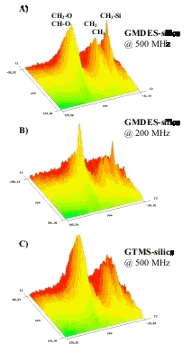
siloxane units in final products. Two-dimensional solid-state NMR
experiments (2D CRAMPS, 2D 1H-13C and 1H-29Si HETCOR, WISE) revealed
differences in structure and segmental dynamics of final films as well
as in self-organization and homogeneity degree depending on reaction
conditions. Ideally, siloxane cage-like clusters are regularly
dispersed within the bulk and oxypropylene chains form phase which
separates organic tails of siloxane clusters. The SAXS determined
distance between clusters (1.8 nm) well corresponds to the constraints
determined by NMR spin-diffusion experiments. Polymer interaction with
silica nanoparticles is confirmed by two-dimensional 1H-29Si HETCOR
experiments.
High
degree of self-assembling of epoxide-based products made from
functionalized organosilica building blocks, functionalized
oligo(oxypropylene)-diamine and/or -triamine, and colloidal silica
nanoparticles was evidenced by solid-state NMR spectroscopy, small
angle x-ray scattering (SAXS) and atomic force microscopy (AFM). Under
optimized conditions of preparation, isolated siloxane cage-like
clusters arise in the reaction mixture. No cleavage of oxirane rings
occurs before thermal curing and thus the whole process is well
controlled. The presence of silica nanoparticles accelerates the
kinetics of polycondensation and affects the condensation rate of
siloxane units in final products. Two-dimensional solid-state NMR
experiments (2D CRAMPS, 2D 1H-13C and 1H-29Si HETCOR, WISE) revealed
differences in structure and segmental dynamics of final films as well
as in self-organization and homogeneity degree depending on reaction
conditions. Ideally, siloxane cage-like clusters are regularly
dispersed within the bulk and oxypropylene chains form phase which
separates organic tails of siloxane clusters. The SAXS determined
distance between clusters (1.8 nm) well corresponds to the constraints
determined by NMR spin-diffusion experiments. Polymer interaction with
silica nanoparticles is confirmed by two-dimensional 1H-29Si HETCOR
experiments.